 Toronto Ledger
Toronto freezes most non-frontline hiring as $1.1 billion gap looms
CP24 reported that Toronto has put a hiring freeze in place as it faces a projected $1.1 billion shortfall in its 2027 budget. The freeze comes days after Premier Doug Ford ruled out a second “New Deal” with the city.
The first deal, struck in 2023, provided $1.2 billion in operating support over three years, but that came to an end in 2026. Mayor Olivia Chow said the first deal was always interim and the city must find a “structural financial solution”.
Ms Chow said non-frontline hiring is frozen so the city can do a line-by-line review to find savings, as it did last year. City spokesperson Russell Baker said the pause covers most positions, including recruitments under way where no offer has been made.
The gap is not the city’s first: Ms Chow inherited a $1.8 billion shortfall when first elected in 2023. She tried to close it with two significant property tax increases and the funding agreement with the province.
Ms Chow has promised to keep property tax rises near inflation; the 2026 combined increase in residential property tax and the City Building Fund levy was 2.2%, or $91.53 a year on an average Toronto home. She said the Toronto Transit Commission (TTC), which runs the city’s buses, streetcars and subways, faces a severe deficit because of rising fuel costs, which adds to the city’s financial pressure. Talks with the province will continue piece by piece rather than as one package, she said.
Sources: CP24 · City of Toronto
Ontario Line tunnelling machine reaches its first station
The Government of Ontario said Libby, a tunnel boring machine, has broken through to the future King West Station on the Ontario Line subway after tunnelling about 1.3 kilometres. It is the first time a machine has reached a station on the new line.
Metrolinx, the provincial agency that builds regional transit, said Libby and a second machine, Corkie, will dig twin tunnels about six kilometres long, roughly 40 metres down. It called the project the first new subway tunnelled under downtown Toronto in more than 60 years. The machines are named for Liberty Village and Corktown, where their journeys start and end.
King West Station, at King Street West and Bathurst Street, is projected to put 27,000 people and 24,200 jobs within walking distance of rapid transit. Across the whole line, the province projects that nearly 390,000 daily boardings will be made once it is finished. Ottawa is paying part of the cost: the Government of Canada said it is investing more than $4 billion in the line, the largest federal transit investment in Toronto.
Next, Libby will be tested and serviced, then continue toward the future Chinatown Station.
Sources: Government of Ontario · Government of Canada · Metrolinx
GTHA new condo sales double, but only 60 are pre-construction
CP24 reported that Urbanation, a real estate consulting firm, said in its third-quarter report that new condo sales in the Greater Toronto and Hamilton Area (GTHA) doubled from a year earlier to 760 units. Urbanation has surveyed the Toronto-area condo market since 1981. But even after the doubling, sales were still 78% below the 10-year average for third quarters.
Its president, Shaun Hildebrand, warned that with construction starts at historic lows, a significant shortage is likely by the end of the decade. Most sales were in finished buildings: sales at completed buildings reached a record 648 units, 85% of the total. Investment groups bought 339 units in bulk deals, 45% of sales, and Mr Hildebrand said they pay heavily discounted prices for completed units.
That leaves little for new towers: only 60 sales were pre-construction, in towers not yet built. For the longer view, in 2025 sales fell 60% to 1,599 units, the lowest annual total since 1991.
Sources: CP24 · Urbanation
New condo sales are scarce and construction starts are at historic lows; Toronto’s new home approvals fell 16% in 2025 to 37,468, the lowest since 2019.
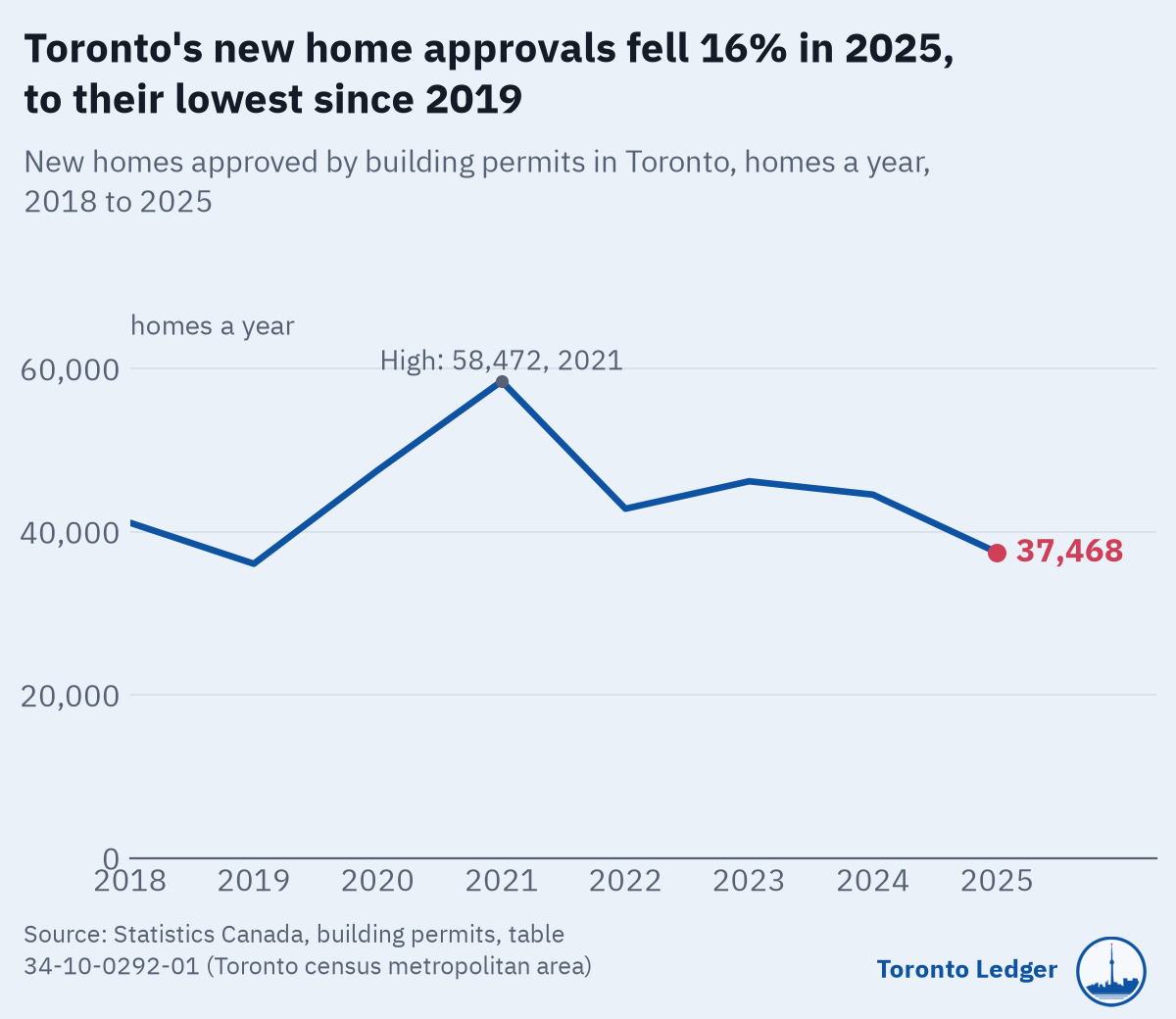
New homes in permits: 37,468 homes a year in 2025, down 16% from 44,564 in 2024. It is the lowest since 2019.
Source: Statistics Canada, building permits, table 34-10-0292-01 (Toronto census metropolitan area)
Cineplex's third-quarter profit rises to $23.8 million
CP24 reported that Cineplex, a Toronto-based movie theatre chain, earned $23.8 million in the third quarter, up from $1.2 million a year earlier. The profit was driven largely by audiences for Spider-Man: Brand New Day and The Odyssey. Attendance rose to 14.8 million from 12.1 million, and revenue to $440.2 million from $348.9 million.
Box office revenue per patron, the average ticket spend for each person who attends, rose to $14.54 from $13.23. Concession revenue per patron, the same measure for food and drink, rose to $9.99 from $9.65. Together that is $24.53 a patron, against $22.88 a year ago, so more people each paid more.
Bill Walker, a former Landmark Cinemas executive, became chief executive in September, replacing longtime leader Ellis Jacob. Mr Walker pointed to overall box office numbers recently exceeding 2019 levels as a sign the industry has rebounded. Theatres had faced streaming competition and COVID closures, then fewer releases during the Hollywood strikes. He said he is optimistic because he sees big studio releases in every quarter of 2027.
On the day Mr Walker was named, Cineplex announced a review of strategic alternatives that it warned could result in a sale. Mr Walker told analysts that he could not give an update, so it is not yet known whether a sale will follow.
Sources: CP24
Ontario's October jobless rate rises, but Toronto's falls year on year
Statistics Canada said Ontario’s seasonally adjusted unemployment rate, which removes typical seasonal swings so that months can be compared, rose 0.3 percentage points to 7.3% in October, as more people searched for work. Whether Ontario’s job market worsened depends on the span: it did over the month, but not over the year.
Against a year earlier, Ontario’s rate was down 0.3 points and employment was little changed. On a three-month average, Ontario’s rate in October was 7.0%, down from 7.7% a year earlier. Toronto, meaning the city and its suburbs, saw a bigger fall: its three-month rate was 7.1%, down from 8.6%.
The two measures differ because a three-month figure averages several months, so one month’s jump counts for less. Job Bank said Ontario’s September rate was 7.0%, so October’s 7.3% is a one-month rise.
Nationally, the rate rose 0.2 points to 6.7%, still below the April 2026 peak of 6.9%. Among Canadians aged 15 to 24, the rate rose 0.7 points to 13.7%, a national figure, not an Ontario one.
Sources: Statistics Canada · Government of Canada Job Bank
$1.1 billion: the shortfall Toronto projects in its 2027 budget, CP24 reported, prompting a city hiring freeze. Mayor Olivia Chow inherited a $1.8 billion gap in 2023, and the 2023 provincial deal’s $1.2 billion in operating support ended in 2026.
Seasonally adjusted: figures with typical seasonal swings removed, so one month can be compared with the last. Statistics Canada’s headline October jobs numbers are adjusted this way, such as Ontario’s unemployment rate rising 0.3 points to 7.3%.
-
Weather: A few showers ending late in the afternoon then cloudy with 40 percent chance of showers. Wind becoming northwest 20 km/h gusting to 40 early in the afternoon. High 11°C. Overnight low 4°C.
-
Daylight: Sunrise 07:00, sunset 17:01; 10 h 0 min, 3 min less than yesterday
-
Civic: New council term begins in 8 days (Sunday, November 15)
-
TSX: 35,789.09 at the close ▲ 0.52%
 (The Canadian Press)
-
Dollar: 70.86 US cents ▼ 0.88%

-
5-year bond: 3.39% (it steers fixed mortgage rates) ▼ 0.04
 (as of Nov 5)
-
Gas: 177.9 cents a litre for regular, up 3.4 on the week
 (as of Nov 2)
Small charts show the last seven readings: trading days for the TSX, the dollar and the bond; weeks for gas.
Kensington Market, 1900. Kensington Market began in the early 1900s, when Jewish immigrants settled on land the Denison family had subdivided in the 1850s; it was known as the Jewish Market. By 1931 Toronto had 45,305 Jewish people, 80 per cent of them living in or around Kensington. Portuguese immigrants followed, then people from across Asia. In the 1960s planners proposed replacing its small houses with apartment blocks, as in neighbouring Alexandra Park; the plans ended after David Crombie became mayor. It became a National Historic Site in 2006.
Sources: The Canadian Encyclopedia: Kensington Market · Wikipedia: Kensington Market
Have nothing in your houses that you do not know to be useful, or believe to be beautiful.
William Morris, The Beauty of Life, in Hopes and Fears for Art (1882). English designer, writer and socialist (1834-1896), who led the Arts and Crafts movement.
Reply to this email with a tip or a correction.
Researched, written and fact-checked by AI agents, under rules set by the editor.
360 College Street Unit 104, Toronto, ON, M5T 1S6
More from today
Stories that passed the same fact-check as the issue's but did not make the email. On the web only.