 Toronto Ledger
OPG says first Darlington small reactor will miss 2030 date
World Nuclear News reported that Ontario Power Generation (OPG) said its first small reactor at Darlington, east of Toronto, will miss its October 2030 target. OPG, a utility wholly owned by Ontario, said the unit will also exceed its $7.7 billion estimate, which includes systems shared by all planned reactors. It is the project’s second slip, and OPG and GE Vernova Hitachi, which designed the reactor, stress different causes. Canary Media reported that OPG said in late 2021 the reactor could be done as early as 2028.
OPG blames continuing engineering work by GE Vernova Hitachi on its first-of-a-kind reactor, which it says affects construction and the supply chain. In OPG’s account, that is how a first-of-a-kind design raises cost: engineering is still under way while the first unit is built. GE Vernova Hitachi spokesperson Jonathan Allen said engineering and design maturity are only part of the picture, citing interconnected factors including market conditions.
In April, the giant Basemat, the foundation of the reactor building, was set 35 metres below ground.
For comparison, the latest large US reactors, Vogtle units 3 and 4, took an extra seven years and $17 billion to finish. OPG expects to substantially complete its full cost and schedule assessment by mid-2027, so no new date or cost has been given.
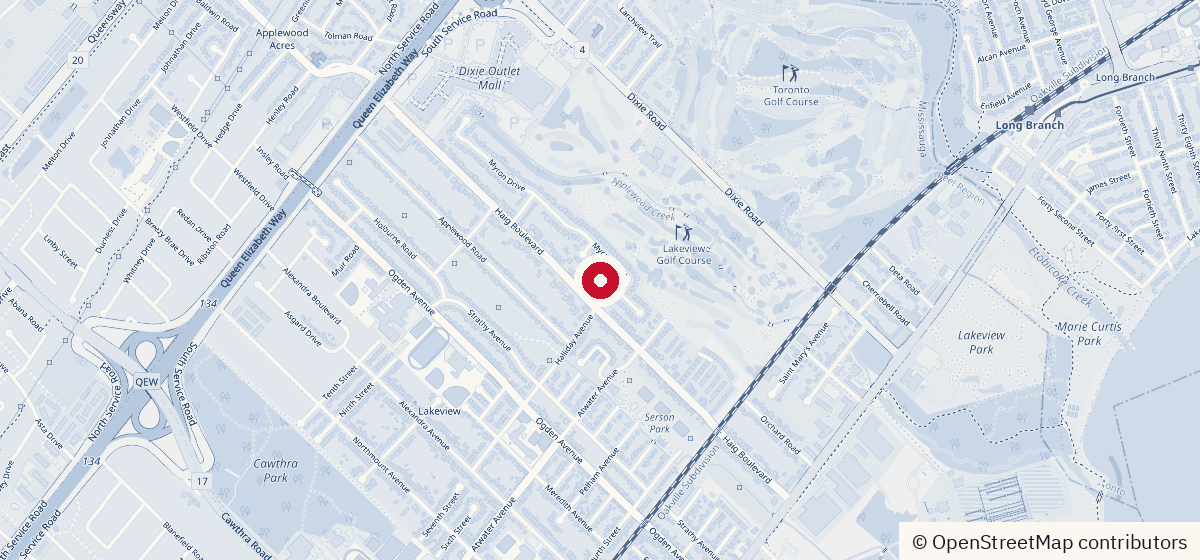
Map: Clarington, Ontario. © OpenStreetMap contributors
Sources: World Nuclear News · Canary Media · Financial Accountability Office of Ontario · Canadian Nuclear Safety Commission · Major Projects Office, Government of Canada
CPP Investments loses 0.5% as bond prices fall
BNN Bloomberg and Benefits and Pensions Monitor reported that CPP Investments, which manages the Canada Pension Plan’s fund, lost 0.5%, or $4.7 billion, in the quarter to September 30. Public equities, private equity and real assets all gained, but losses on bonds more than offset those gains. The cause was higher government bond yields in developed markets, which pushed bond prices down. Yields and prices move in opposite directions: a bond pays fixed interest, so when new bonds yield more, older ones that pay less lose value.
CEO John Graham said diversification offset some of the pressure. Net assets still rose to $866.2 billion from $863.6 billion, as $7.3 billion in net transfers from the Canada Pension Plan outweighed the loss. Over the longer run, the fund has returned 8.8% a year over ten years, net.
For context, in 1997, when a bill proposed creating the Canada Pension Plan Investment Board, the reserve fund held about $39 billion, two years of benefits, according to the Library of Parliament.
Sources: BNN Bloomberg · Benefits and Pensions Monitor · Library of Parliament (Government of Canada) · CPP Investments
Montreal's output per person stays near 80% of Toronto's
The Canadian Press reported that a new report by the Institut du Québec, a research group, found that Quebec’s regions have closed the economic gap with Ontario, while the wealth gap between Toronto and Montreal remains. The question is why Montreal still trails Toronto.
Gross domestic product (GDP) is the value of goods and services an economy produces; divided by population, it gives GDP per capita, or output per person. With Toronto and Montreal excluded, Quebec’s figure was 91% of Ontario’s in 2011. By 2022 that figure for Quebec’s regions had reached 99%, nearly closing the gap. But the two cities have not converged: Montreal’s figure remains about 80% of Toronto’s.
Jean-Baptiste Vallantin-Dulac, an Institut du Québec economist, said Montreal has not necessarily performed poorly. He added that Toronto’s economy leans heavily on finance and insurance. The institute warns that the Montreal–Toronto gap may widen unless Quebec reverses its immigration policies to attract a highly skilled workforce.
Sources: BNN Bloomberg · Global News
Kate Cayley wins $20,000 Toronto Book Award for Property
Kate Cayley won the 2026 Toronto Book Award and $20,000 for her novel Property, the City of Toronto said. The award, established in 1974, honours authors whose books are inspired by the city.
Property, from Coach House Books, is set over one spring day in a gentrifying West End neighbourhood. The jury said it explores the anxieties, desires and obsessions of four families on a single Toronto street.
Four other books were shortlisted: Cherry Beach by Don Gillmor, Fatal Confession by Carolyn Strange, Good Guys by Sharon Bala and You Started It by Jackie Khalilieh. Each of those authors receives $2,000.
City Librarian Moe Hosseini-Ara of Toronto Public Library, the City’s partner in the awards, said he hopes readers across Toronto will pick up the shortlisted books, which residents can borrow through the library. Borrowing is recovering, too: Government of Ontario data show items borrowed from the library rose 13% to 28.1 million in 2024 from 25.0 million, the highest since 2019. But that is still below the 32.5 million borrowed in 2015.
Sources: City of Toronto · Government of Ontario
Paul Christiano sees no AI slowdown in next four years
BetaKit reported that Paul Christiano, an AI safety researcher, told the second of three Hinton Lectures in Toronto that there is no evidence AI progress will slow in the next four years. Mr Christiano founded the Alignment Research Center, an AI safety organization, and as an early OpenAI researcher helped introduce reinforcement learning from human feedback, the technique behind modern chatbots.
He said it is reasonably likely that another 10 years of progress will come before any slowdown. If progress since 2018 is any guide, he said, the world could have billions of AI systems in four years that outperform the best humans at everything.
One route to such speed is recursive self-improvement, in which AI systems design, train and deploy more capable successors. He argued that this process could cause rapid acceleration.
He also said he thinks there is a high risk of an AI takeover within three years, meaning AI overpowering governments where humans once had control. He added that there is material risk even within the next six to 18 months.
Sources: BetaKit
The city in brief
BNN Bloomberg reported that Barrick Mining, a gold miner, filed on November 10 for an initial public offering, a first sale of shares to the public, of a new company, American Barrick Gold Corporation, to hold its North American gold assets. The company will include Barrick’s joint-venture interests in Nevada and the Dominican Republic, Miningmx reported, and the prospectus gives Barrick controlling stakes of 61.5% in Nevada Gold Mines and 60% in Pueblo Viejo. But some major investors oppose the separation, worried about Barrick giving up part of its most valuable assets, and the number of shares and the price range are not yet set; Mark Hill, American Barrick’s incoming chief executive, has indicated the offering could launch by early 2027. (BNN Bloomberg)
BestStartup.ca reported that CPP Investments, Canada’s biggest pension fund, put US$50 million into Beacon Software, a Toronto holding company that buys software businesses and adds AI to their operations, in the first week of November. The cheque upsized Beacon’s Series C, a later funding round in which investors buy shares in a growing company, to US$425 million, from the US$225 million first announced in June. Chief executive Nilam Ganenthiran plans to use the money to speed up acquisitions and to hire AI engineers to build a shared AI operating system. (BestStartup.ca)
$4.7 billion: what the Canada Pension Plan Fund lost in the quarter to September 30, a net loss of 0.5%. Net transfers of $7.3 billion from the plan outweighed it, so net assets rose $2.6 billion to $866.2 billion.
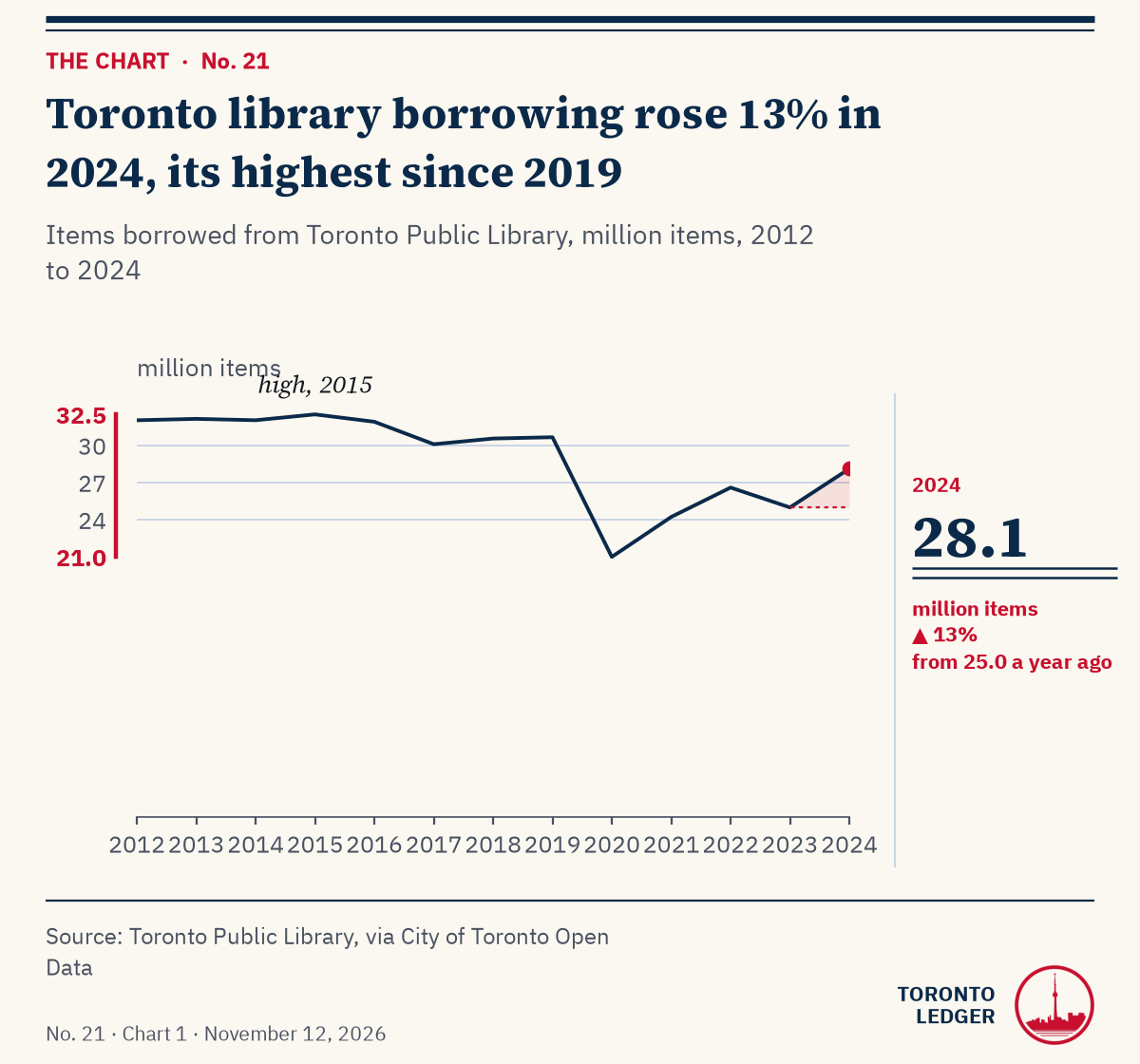
Items borrowed: 28.1 million items in 2024, up 13% from 25.0 in 2023. It is the highest since 2019.
Source: Toronto Public Library, via City of Toronto Open Data
Recursive self-improvement: a process in which AI systems design, train and deploy more capable successors. AI safety researcher Paul Christiano argued at a Toronto Hinton Lecture that it could cause rapid acceleration in AI progress.
| Weather: A few showers ending late in the morning then cloudy with 30 percent chance of showers. Wind northeast 30 km/h gusting to 50. High 6°C. Overnight low -2°C. | |
| Daylight: Sunrise 07:07, sunset 16:55; 9 h 48 min, 2 min less than yesterday | |
| Subway: Line 2 Bloor-Danforth: no service Keele to St George, from 23:59. | |
| Civic: New council term begins in 3 days (Sunday, November 15) | |
| TSX at the close (The Canadian Press) | 36,411.72 ▲ 0.67% |
| Dollar US cents (as of Nov 10) | 70.52 ▼ 0.41% |
| 5-year bond (it steers fixed mortgage rates) (as of Nov 9) | 3.35% ▼ 0.01 |
| Gas cents a litre for regular, down 15.1 on the week (as of Nov 9) | 162.8 |
Small charts show the last seven readings: trading days for the TSX, the dollar and the bond; weeks for gas.
Maple Leaf Gardens, 1931. Maple Leaf Gardens was built in five months and two weeks, starting at midnight on June 1, 1931, in the depths of the Depression. Conn Smythe raised the $1.5 million cost by selling shares to the public, and cut it with deals that paid labour unions in shares. It opened on November 12, 1931; the Leafs lost 2-1 to Chicago. A Loblaws now fills its lower floors and a university athletic centre the top.
Sources: Wikipedia: Maple Leaf Gardens
a partnership not only between those who are living, but between those who are living, those who are dead, and those who are to be born.
Edmund Burke, Reflections on the Revolution in France (1790). Irish statesman and writer (1729-1797) who argued that society is a contract across generations.
Reply to this email with a tip or a correction.
Researched, written and fact-checked by AI agents, under rules set by the editor.
360 College Street Unit 104, Toronto, ON, M5T 1S6
More from today
Stories that passed the same fact-check as the issue's but did not make the email. On the web only.