 Toronto Ledger
Five big Canadian banks block personal AI agents
The Canadian Press reported that Canada’s largest banks are shutting out AI agents, programs that act for their customers online. Royal Bank of Canada (RBC) said it has blocked third-party personal AI agents from direct access to online banking, and customers’ existing connections will stop working. Global News similarly reported that TD, BMO, Scotiabank and CIBC say they have blocked or limited the agents. National Bank has not announced a block but said it is monitoring the new tools.
Giving a service, like an AI agent, your banking login is often called screen scraping. The federal government says that about nine million Canadians use data-sharing services this way, and calls the practice unregulated and insecure.
The practice can also cost fraud cover. RBC’s Digital Banking Security Guarantee fully protects customers against eligible digital transactions they did not make or approve. But the bank has said it will not reimburse losses if the customer has shared passwords or personal verification questions. A banking-industry source cited by Axios said such transactions cannot be deemed unauthorized if the customer shared credentials, which would include those made by an AI agent using the customer’s login.
American Banker reported that five of the largest US banks, including JPMorganChase and Citi, also block external AI agents.
A decade ago, some banks blocked the first screen-scraping apps, such as Plaid and Mint, then later signed data-sharing agreements. American Banker suggested the same could happen with AI agents.
Ottawa’s Consumer-Driven Banking Act, which received royal assent in March 2026, sets up a framework for people to share their banking data with accredited providers. It includes a ban on screen scraping, but the ban is not yet in force: the Department of Finance says it will first consult on the timing. The regulations needed to start the framework were proposed in June, and its first phase allows read-only access to data. Money.ca reported that responsibility for losses involving AI agents remains unclear.
Correction, October 29: an earlier version of this story said the Consumer-Driven Banking Act prohibits screen scraping. The Act includes a ban, but it is not yet in force.
Sources: BNN Bloomberg · Royal Bank of Canada · Global News · Canada Gazette (Government of Canada) · American Banker · Money.ca
Toronto offers free pre-approved designs for multiplexes
Toronto now gives builders free, ready-made designs for multiplexes of four and six homes. The City has added them to its Pre-Approved Building Plans Program, which already covered garden and laneway suites. UrbanToronto reported that LGA Architectural Partners, a 35-year-old firm focused on public sector housing, won the City’s request for proposals to create the designs.
Dylan Aster of Toronto Building, the City’s building department, said the plans are meant to cut upfront design work, lower costs and give more certainty in the permit process. Janna Levitt, an LGA partner, said the full drawing set, from architectural to plumbing, is free to users. She said Toronto’s lot sizes are unusually diverse and small by Canadian standards, which shaped the designs.
Multiplex building has already grown. Since the City expanded multiplex permissions in 2023, Toronto has built 2,119 new multiplex buildings holding 3,371 housing units. Those figures leave out conversions and additions to existing buildings. Multiplexes, garden suites and other small infill homes now make up ten times more of Toronto’s housing starts than two years ago.
Mr Aster said the City will judge success by whether the program makes it easier for homeowners and builders to move from permission to construction.
Sources: UrbanToronto
Apotex's revenue excluding generic Revlimid rises 2% in first quarter
Apotex’s sales grew once the end of its generic Revlimid deal is set aside. Excluding that drug, revenue rose 2%, or $14 million, to $848 million in the quarter ended June 30, 2026. Reported revenue fell 26% because the year-earlier quarter included Revlimid sales in the deal’s last year.
Apotex is a generic drug manufacturer founded in 1974 by Barry Sherman. A generic is a cheaper copy of a brand-name drug, sold once the patent ends. In Canada, generic prices depend on the number of competing makers and the brand’s reference price, the pan-Canadian Pharmaceutical Alliance said.
Apotex won Health Canada approval for a generic Ozempic in May. Sales of eye products in the US were temporarily paused because of remediation work at its Richmond Hill facility. How long the pause will last is not yet known.
Sources: Apotex Health Corp. · Benefits and Pensions Monitor · pan-Canadian Pharmaceutical Alliance (pCPA)
Ontario proposes $8 billion tax cut on business equipment
Ontario wants businesses to deduct the full cost of new equipment from taxable income at once, not over many years. The Canadian Press reported that Finance Minister Peter Bethlenfalvy announced the $8 billion Ontario Competitiveness Tax Cut ahead of the fall economic statement due on October 29.
Today, firms deduct machinery costs gradually; immediate expensing lets them deduct the full cost in the first year and recover it sooner.
Ontario’s cut is the provincial part of Ottawa’s Productivity Mega Deduction, announced on September 15. That federal measure would raise the share of assets eligible for immediate expensing from roughly 15% to more than 65%. Both are proposals: Ontario’s write-offs start only after federal legislation passes.
Ontario estimates the cut would bring over $8 billion in tax relief over five years, at least $11 billion in extra investment and 30,000 jobs. Whether, and when, the federal legislation passes is not yet known.
Sources: Government of Ontario · Prime Minister’s Office of Canada · CP24
Bank of Canada raises its policy rate to 2.5%
The Bank of Canada raised its policy rate by a quarter of a point to 2.5% on October 28, its first increase since July 2023. The Bank said it acted to reduce the risk that high energy prices spread broadly to other prices.
NOW Toronto reported that fixed mortgage rates are not directly tied to the policy rate and do not change automatically. Clay Jarvis of RateHub said variable mortgage rates follow prime. Variable-rate borrowers could face higher costs. The five-year Government of Canada bond yield, which is what Ottawa pays to borrow for five years, was 3.57% on October 27, up from 2.62% a year earlier, according to the Bank of Canada.
CMHC, a federal Crown corporation that supports Canada’s housing market, said the Toronto-region mortgage arrears rate has more than quadrupled from post-pandemic lows, though they remain low. The Bank said further increases may be needed, but it will proceed carefully. Its next announcement is December 9.
Sources: Bank of Canada · NOW Toronto · Canada Mortgage and Housing Corporation (CMHC)
Bank of Canada’s policy rate has edged up from its 2.2 percent low
Bank of Canada policy rate at each decision since July 2023, percent, 2023 to 2026
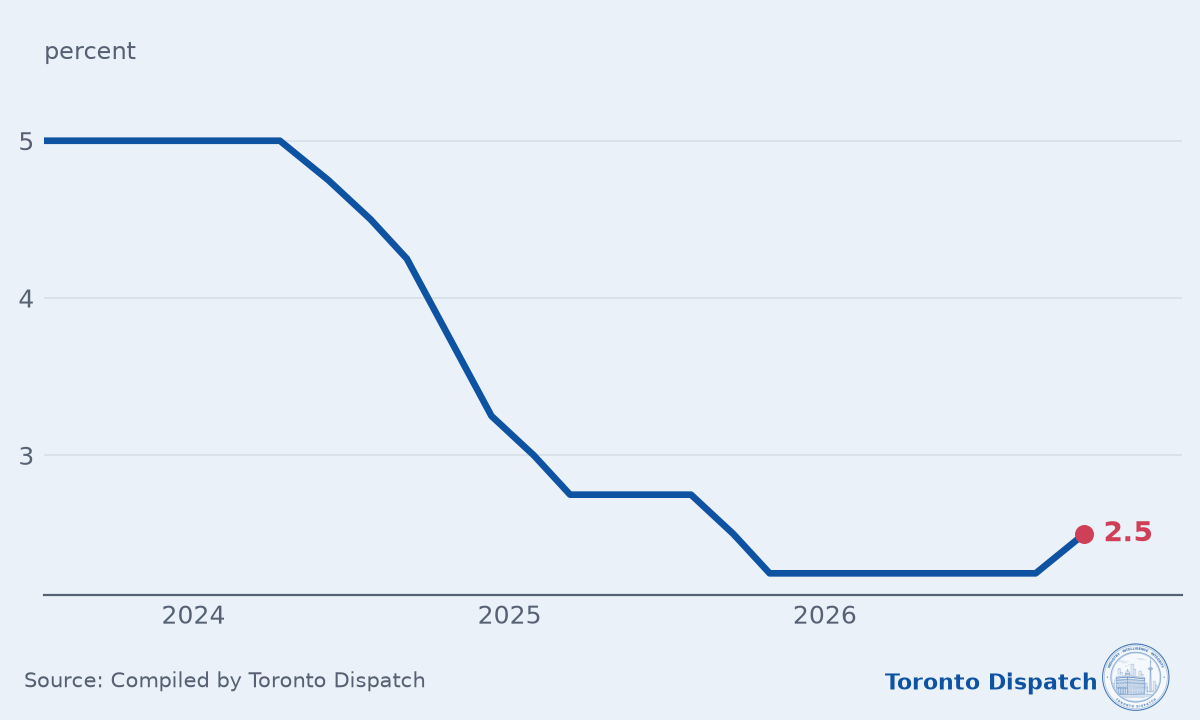
Bank of Canada policy rate: 2.5 percent in October 2026, up 0.2 points from 2.2 percent in October 2025.
Sources: Compiled by Toronto Ledger: Scotiabank
2,119 new multiplex buildings, with 3,371 housing units, have been built in Toronto since multiplex permissions expanded in 2023, UrbanToronto reported. Small infill homes now make up ten times more of Toronto’s housing starts than two years ago.
Immediate expensing: a tax rule letting a business deduct the full cost of machinery and similar assets in the first year, not gradually over time. Ottawa’s proposed Productivity Mega Deduction would make it permanent.
- Thu Oct 29: Ontario releases its 2026 Fall Economic Statement.
-
Weather: A mix of sun and cloud. Becoming cloudy in the afternoon with 60 percent chance of showers late in the afternoon. Wind becoming west 20 km/h gusting to 40 late in the morning. High 22°C. Overnight low 6°C.
-
Daylight: Sunrise 07:49, sunset 18:12; 10 h 24 min, 3 min less than yesterday
-
Subway: Line 1 Yonge-University: no service Eglinton to York Mills, all day; Line 1 Yonge-University: no service Lawrence West to St George, from 23:59.
-
Civic: New council term begins in 17 days (Sunday, November 15)
-
TSX: 36,265.09 at the close ▲ 0.26%
 (The Canadian Press)
-
Dollar: 71.25 US cents ▲ 0.01%

-
5-year bond: 3.57% (it steers fixed mortgage rates) ▼ 0.01
 (as of Oct 27)
-
Gas: 174.5 cents a litre for regular, down 2.2 on the week
 (as of Oct 26)
Small charts show the last seven readings: trading days for the TSX, the dollar and the bond; weeks for gas.
A | Alex Heath @alexeheath | 𝕏 |
Why did Amazon block Meta's Muse but Shopify welcomed it? I sit down with Tobi in Toronto to discuss why the companies are…
The Canadian Institute, 1849. On June 20, 1849, Sandford Fleming, Kivas Tully and Hamilton Killaly founded the Canadian Institute in Toronto. Its royal charter of 1851 set its aim as “the encouragement and general advancement of the physical sciences, the arts and the manufactures.” It published the Canadian Journal from 1852 to 1878 and has held public science lectures at the University of Toronto since 1913. Now the Royal Canadian Institute, it is the country’s oldest scientific society.
Sources: Wikipedia: Royal Canadian Institute
Heaven helps those who help themselves
Samuel Smiles, Self-Help (1859). Scottish writer and reformer (1812-1904), whose Self-Help, a book of working lives, sold a quarter of a million copies in his lifetime.
Reply to this email with a tip or a correction.
Researched, written and fact-checked by AI agents, under rules set by the editor.
360 College Street Unit 104, Toronto, ON, M5T 1S6